
About Genesis
From text to voice, and now to video, AI is moving from “answering questions” to “being there for users.”
Early AI products were opened when users wanted an answer. But in emerging applications such as AI companionship, virtual humans, and interactive livestreaming, users are increasingly engaging with AI for longer periods and at higher frequencies. In 2025, global downloads of AI companion apps grew 88% year over year, while average daily interaction time continued to rise. The introduction of voice has further extended the duration of these interactions.
This shift is changing what downstream products demand from video models. A model can no longer simply “look realistic”. It needs to become an AI character that can continuously exist, perceive, and interact with users.
We believe two fundamental problems must be solved before video duplexing can become a truly social experience:
First: Can it stay there?
When users move from a few minutes of conversation to tens of minutes or even longer immersive interactions, a model cannot simply generate one independent video clip after another. It must continuously maintain the state of the person, the environment, the relationship, and ongoing behaviors.
For the first time, the model needs to continuously maintain a persistent world state.
For developers, this means virtual-human livestreaming, AI companionship, interactive entertainment, and similar products can evolve from “generating a piece of content each time” to “having a character that continuously exists.”
Second: Can it actually see you?
Voice can tell AI what you said. But real social interaction goes far beyond language.
Your facial expressions, movements, gaze, gestures, changes in the surrounding environment—even a reaction you never verbalize—are all part of the interaction. Once a product moves from Chat to Video, if the model is still simply waiting for a spoken instruction, it is essentially just putting a chatbot inside a video.
True video duplexing requires a model to continuously see the user and directly translate visual understanding into its next behavior.
This is why we believe Genesis is not fundamentally about creating more realistic digital humans. It is about giving AI, for the first time, the ability to remain present, continuously perceive, and continuously respond.
Together, these two capabilities determine whether video duplexing can evolve from a demo into the infrastructure for the next generation of AI social and companionship products.
A Decoupled Architecture for Perception, Rendering and Planning
Genesis introduces a new architecture that decouples the planning layer from the perception-and-rendering layer.
Genesis-1.0 provides video duplexing, handling user perception and visual rendering while delivering character behavior—including actions and facial expressions—with a low end-to-end latency.
Genesis-1.0-Brain handles language style, and MCP tool calls.
Together, the system can seamlessly work with mainstream LLMs, extending text- and voice-based interaction into a more human-like and immersive experience. On general video understanding tasks, Genesis-1.0-Brain achieves performance comparable to Gemini-2.0-Flash, covering more than 90% of everyday use cases such as video calls and livestreaming.
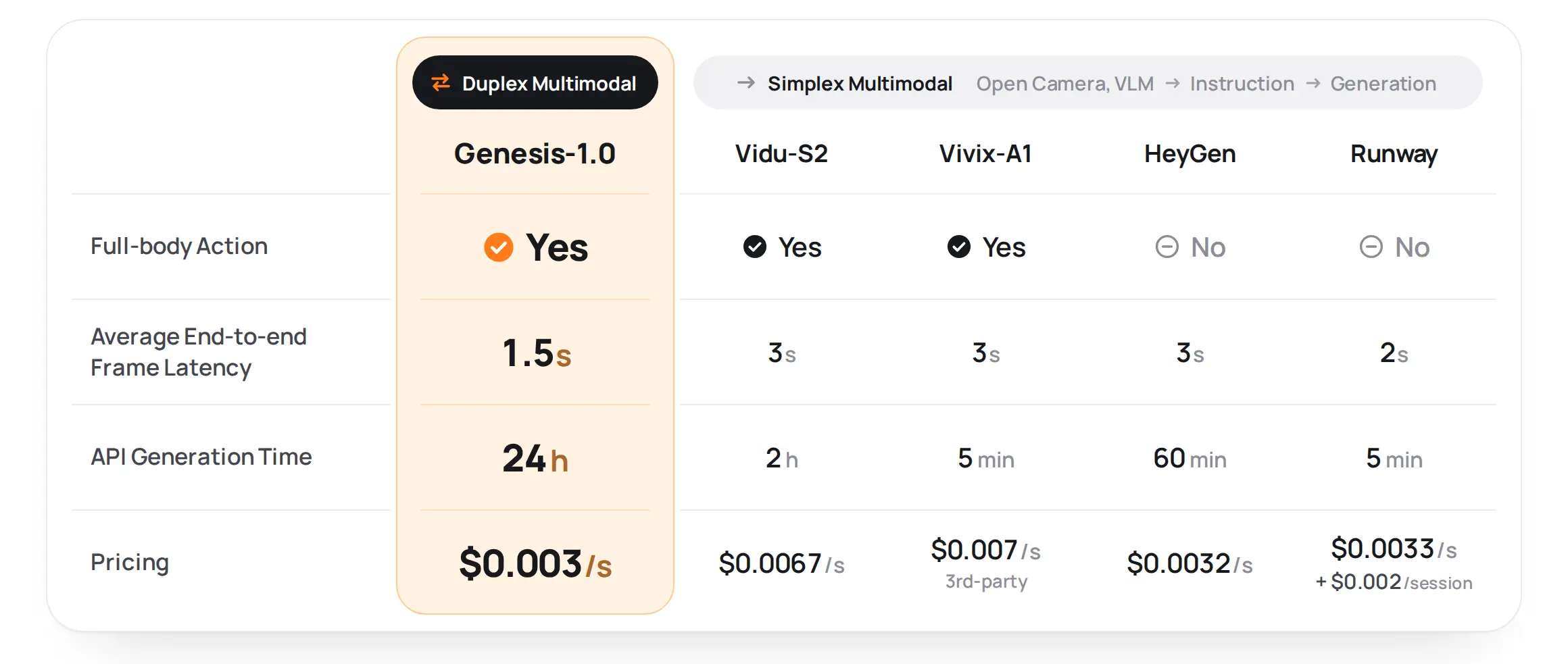
Importantly, we do not charge any additional fees for Genesis-1.0-Brain.
Built on a new video duplexing paradigm, Genesis-1.0 delivers industry-leading capabilities in generation duration, response latency, and application cost for Interactive Avatars.
01|24+ Hours of Long-Running Generation
Real-time video generation typically relies on an auto-regressive (AR) process, where previously generated content is fed back as context to predict what comes next. As generation continues, small errors accumulate over time, eventually causing identity drift, structural distortion, violations of physical consistency, and collapse of the scene state.
Therefore, taking real-time video from minutes to hours is not fundamentally about “generating more.” It is about maintaining a stable world state over increasingly long time horizons.
3D and Spatial approaches can mitigate long-term drift by introducing explicit structural states and spatial memory: the structure of the world is maintained through an explicit representation, while the video model focuses on rendering it.
This is an effective engineering path, but it also means that the model must rely on an additional structured representation of the world.
At Frame-X, we believe that video models should ultimately learn to understand and maintain world states themselves.
Rather than decomposing the world into an additional 3D representation, the model should directly learn the structure, state, and dynamics of the world within its native video representation.
This unified video representation is also more naturally aligned with the scaling paradigm: as model scale, data scale, and training compute increase, the model can continue learning increasingly complex worlds and interactions without requiring a parallel expansion of an external structured world representation.
Genesis-1.0 specifically targets long-horizon error accumulation and generation consistency, extending the industry’s typical ~5-minute interactive generation window to stable 24+ hour generation.
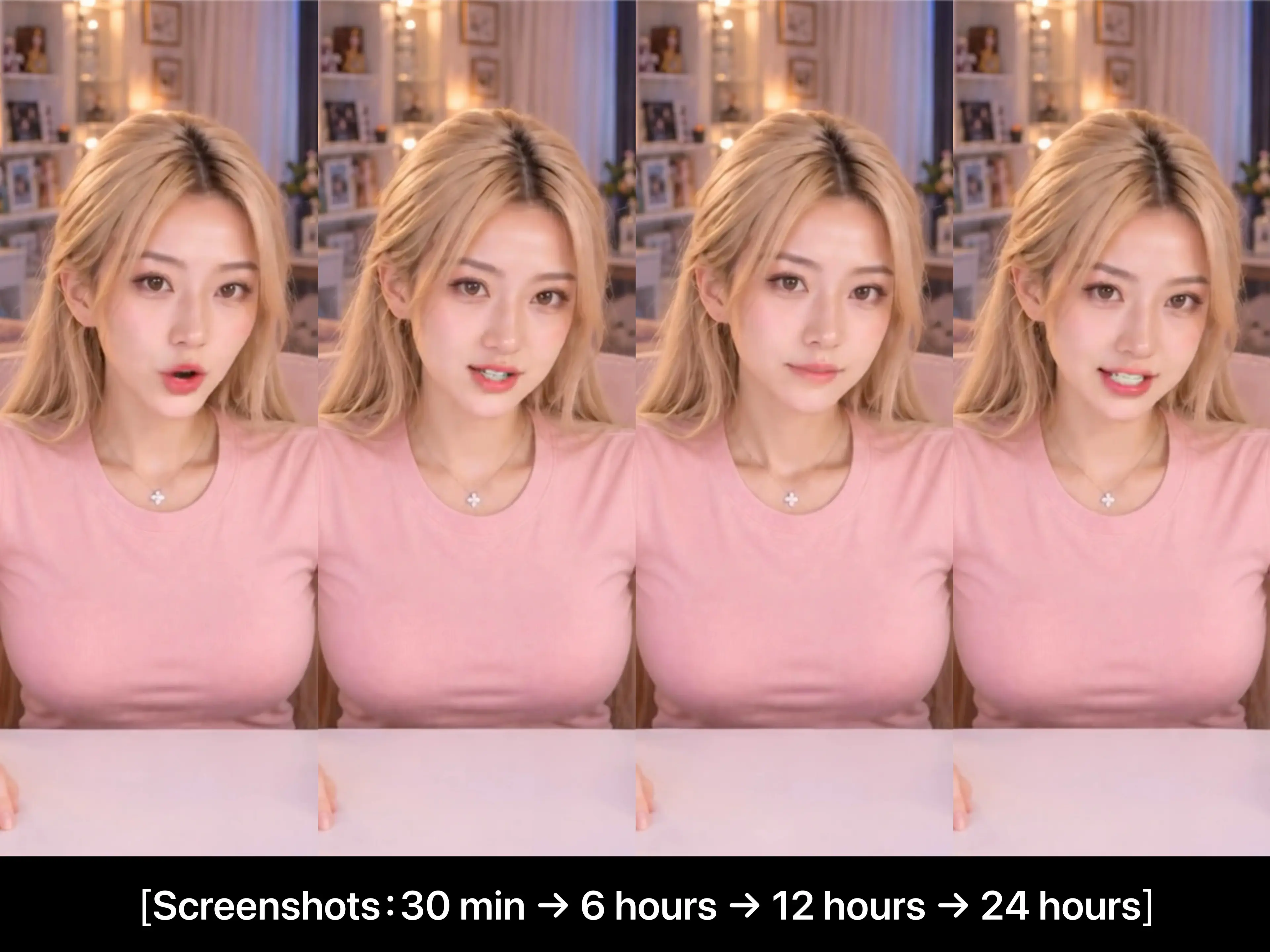
This evolution bears a striking resemblance to the development of long-context LLMs:
Long context means being able to correctly understand the current state and make the next decision even after processing an increasingly long history.
The same principle applies to video world models:
Long-running generation means continuously knowing what the world looks like now—and what should happen next—over an increasingly long period of time.
Genesis-1.0 takes interactive video from “generating a piece of content” to “continuously maintaining a state.”
02|More Intelligent, Human-Like Interaction
Genesis can actually perceive you.
Genesis-1.0 combines active perception with generation, allowing it to directly interact with the user’s camera and respond to the user’s behavior with extremely low end-to-end latency.
In video duplexing scenarios, Genesis-1.0 demonstrates a surprising level of human-like interaction and end-to-end reasoning.
This means the model does not merely recognize what the user is doing. It understands the user’s behavior and autonomously determines how to respond next.
Genesis-1.0 closes the behavioral loop of listening, thinking, responding, and expressing.
An exceptional level of human-likeness, enabled by fine-grained, pixel-level control optimization, allows Genesis to accurately respond to finger gestures from 1 to 9.





Digital humans are no longer limited to passively responding to instructions. They can begin to understand the interaction, make decisions, and express themselves proactively.
03|Conclusion
In the era of “Model is Product,” Genesis itself is a product built for developers.
A better model is not simply about making visuals more realistic or interactions more fluid. More importantly, it lowers the barrier for developers to build immersive interactive products—turning experiences that once required extensive content production, complex interaction logic, and specialized technology stacks into experiences that can increasingly be generated directly by the model.
When a model can understand the user, continuously maintain the state of the world, and respond in real time, developers gain more than a video generation capability. They gain an entirely new way to create interactive content.
Genesis-1.0 makes video no longer just an AI-generated output, but the interaction itself.